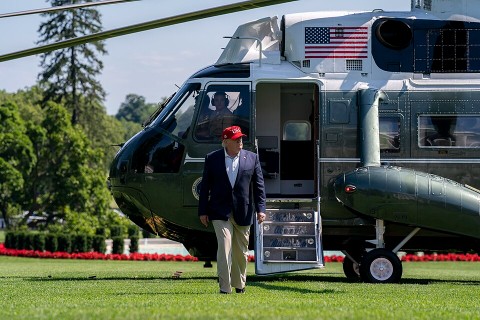
In a potentially contentious move, former President Donald Trump declared his intention to speak with Taiwan’s President Lai Ching-te, a step that could strain U.S.-China relations. Speaking to reporters at Joint Base Andrews in Maryland, Trump asserted, “I’ll speak to him,” in response to inquiries about Lai, emphasizing his willingness to address what he referred to as the “Taiwan problem.” This announcement follows a history of delicate diplomatic relations, as U.S. leaders have not communicated directly with Taiwanese presidents since Washington recognized Beijing diplomatically over Taipei in 1979.
Taiwan’s foreign ministry expressed President Lai’s readiness to engage in dialogue with Trump, marking a continuation of the island’s openness to communication. The last notable breach of protocol occurred in late 2016 when Trump, then president-elect, spoke with Taiwan’s then-President Tsai Ing-wen. That conversation prompted a strong reaction from Beijing, which lodged a formal complaint, while Trump’s team downplayed its significance.
China has consistently viewed Taiwan as its territory and has not ruled out the use of force to assert control over the island, which is democratically governed. Trump’s remarks come amidst ongoing tensions, with China disapproving of U.S. military support for Taiwan intended to deter potential Chinese aggression. Despite Trump’s acknowledgment of his “amazing” relationship with Chinese President Xi Jinping, the former U.S. leader has not yet confirmed whether he will proceed with a substantial $14 billion weapons sale to Taiwan, adding further uncertainty to the U.S.’s stance.
Trump’s administration has reportedly authorized more arms sales to Taiwan than any previous U.S. president, yet he has also called future sales a “very good negotiating chip.” Meanwhile, China’s government has allegedly delayed approval for a planned visit to China by Elbridge Colby, the Pentagon’s undersecretary of defense for policy, pending Trump’s decision on the weapons sale. This development highlights the intricate balance of diplomacy and military strategy at play.
While Lai is eager to discuss maintaining the status quo across the Taiwan Strait, which he claims China threatens with its military buildup, Trump’s language has sent mixed messages to Taipei. His reference to the “Taiwan problem” echoes Beijing’s terminology, creating ambiguity about U.S. intentions. Despite these complexities, U.S. law mandates that Washington support Taiwan’s self-defense capabilities, a stance backed by bipartisan pressure from U.S. lawmakers to continue arms sales. Taiwan’s strategic importance to the U.S. is underscored by its status as a major trading partner, particularly in the semiconductor sector essential to the global economy.