
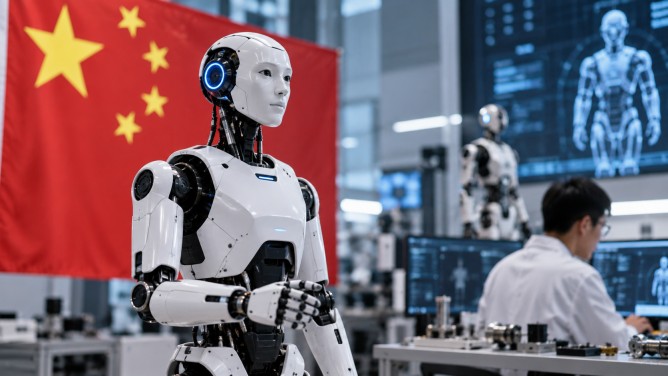
The field of humanoid robotics is nearing a significant milestone as Chinese companies rapidly advance in the development of embodied intelligence. Recent attention was captured by the World Humanoid Robot Games held in Beijing, where Chinese-manufactured robots showcased extraordinary capabilities by competing in various athletic events. Some of these robots even managed to outperform existing human records, notably surpassing the 9.58-second 100-meter sprint record set by Usain Bolt and the 43.03-second 400-meter record held by Wayde van Niekerk.
This swift progress has heightened competition among Chinese robotics firms, all vying for supremacy in this burgeoning industry. The developments have sparked a critical question: Has the humanoid robotics sector reached its pivotal “iPhone moment”? This term, popularized by Nvidia CEO Jensen Huang in 2023, refers to a groundbreaking technological shift that propels an innovation from an emerging idea to widespread adoption, fundamentally transforming industries and user interactions.
At the forefront of this conversation is Wang Xingxing, the founder and CEO of Unitree Robotics, a leading Chinese humanoid robot manufacturer. Wang shared his perspective on the potential timeline for embodied intelligence reaching such a revolutionary point. He predicted that a tipping point akin to the “ChatGPT moment” could be achieved in two to three years, although a more conservative estimate suggests it might take five to ten years under slower development conditions.
Wang voiced these insights during the 2026 World Robot Conference held in Beijing on August 20. His remarks coincided with Unitree’s notable debut on the Shanghai Stock Exchange’s STAR Market, where the company’s shares surged, closing 460 percent higher. This stock market success further underscores the growing interest and investment in the field of humanoid robotics as stakeholders worldwide eagerly watch for the next big breakthrough.