
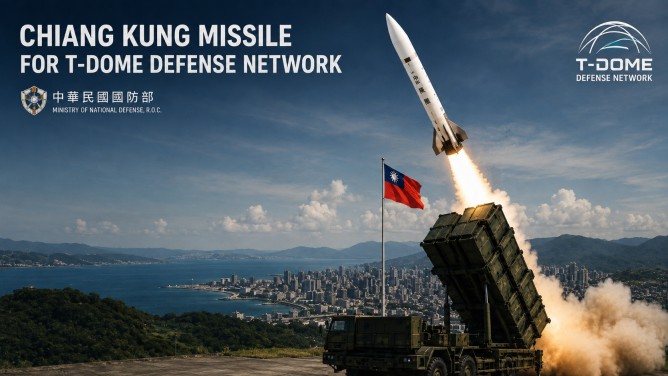
Taiwan’s defense capabilities are set to expand with the development of the Chiang Kung missile, a high-altitude interceptor that will be integral to the country’s proposed “T-Dome” integrated air defense network. Also referred to as Tien Chien IV, this missile is engineered to intercept ballistic threats at altitudes reaching 70 kilometers. It features a land-based vertical launch system and a two-stage solid-propellant rocket, with vectored thrust to enhance its maneuverability at high altitudes.
The National Chungshan Institute of Science and Technology (NCSIST) has unveiled the missile’s technical specifications, highlighting its advanced radar that can detect various target types and simultaneously engage multiple tactical ballistic missiles. This capability is crucial for countering electronic warfare threats. The system also boasts a mobile active electronically scanned array radar, designed to operate effectively in environments plagued by electromagnetic interference and GPS jamming.
With the introduction of the Chiang Kung missile, Taiwan aims to fill a gap in its high-altitude interception capabilities, providing a significant enhancement to its current air-defense systems under the envisioned T-Dome network. This initiative is part of Taiwan’s broader strategy to bolster its defense posture in the face of growing regional tensions and military advancements by neighboring countries.
Despite its promising features, the program’s future is clouded by budget uncertainties. The Chiang Kung missile was not included in Taiwan’s special defense budget, prompting the Ministry of National Defense to seek alternative funding through a supplementary budget. Officials have cautioned that any delays in securing the necessary funds could disrupt the acquisition timeline and impact the overall development of the T-Dome network.
The successful integration of the Chiang Kung missile into Taiwan’s defense infrastructure is seen as a critical step in ensuring the nation’s security. As Taiwan navigates these budgetary challenges, the outcome of this program will likely have significant implications for its defense strategy and regional stability.